
Cambium Data Blog
Cambium Data has been serving the Omaha area since 2009, providing IT Support such as technical helpdesk support, computer support, and consulting to small and medium-sized businesses.


Nowadays, businesses of all sizes rely so, so much on data. This makes it a hugely valuable asset. Unfortunately, it is also one of the most vulnerable.
We’ve reached a point where the cybersecurity protections most have relied on for years—things like basic antivirus and its ilk—just aren’t enough to properly protect against modern attacks and their ramifications. To really protect your business, you need protections like Managed Detection and Response.
0 Comments

Every day, your business is a data-producing machine. Your staff is firing off emails, drafting contracts, updating customer spreadsheets, and saving financial reports. This data isn't just a byproduct of your hard work; it’s the actual engine that keeps the lights on.

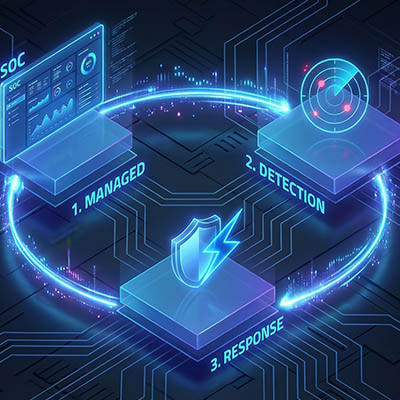
Imagine getting to the office Tuesday morning, ready for another productive day, when your lead admin walks in with bad news. The file infrastructure is down, and so is everything else. It’s been encrypted by ransomware, and you’re the latest target of a zero-day ransomware attack that managed to bypass your antivirus. What do you do?

Most business owners I meet have a backup plan. In the worst situation, it's a lone external drive humming in the corner or a basic cloud sync. While these are good first steps, they often harbor a hidden danger: a single point of failure. If your office faces a fire, that external drive is toast. If a staff member accidentally wipes a folder and it instantly syncs to the cloud, your data could vanish before you even realize it's gone. To build a strategy you can actually sleep on, we use the 3-2-1-1 Rule.

Can you say with absolute certainty that your business could survive a total server failure tomorrow morning? If the answer is no, then you have work to do getting your data backup systems into a better place. Most small businesses believe that having a backup running is the same as their data being safe, but that’s simply untrue. Having a backup is half the battle; making sure the backup works is another story.

Over the next week or so, countless gingerbread houses will be created and then consequently destroyed. During that initial creative process, you’ll get to see careful preparation and precision, which should yield a longer-lasting, more sustainable product. You can apply a similar philosophy to handling your business’ data; with the right structures in place (like the 3-2-1 rule for data backup), you’ll find that your data is more resilient, sound, and less prone to, well, crumbling.
If you are one of those business owners that has gone out of their way to pay cybersecurity insurance premiums, you probably think that they will shield you from situations that could put your business at risk. What if, however, you are just paying for the paperwork?
Picture this scenario: You suffer a ransomware attack, your business has to shut down in order to take this massive problem head-on, and rightfully, you file a claim expecting to activate the policy which you routinely pay for. Weeks later, you receive a denial letter over a technical requirement buried deep in the fine print.

Data backup is one of those vital tools your business needs that it’s impossible to get away from. If you don’t have it, your company is at risk of losing countless years of progress, and if you don’t have contingencies in place, even its future could be in question. Here are three vital types of data that your business needs to protect with data backups.
Of course, you should have all data backed up; there are three important types just to prove our point.
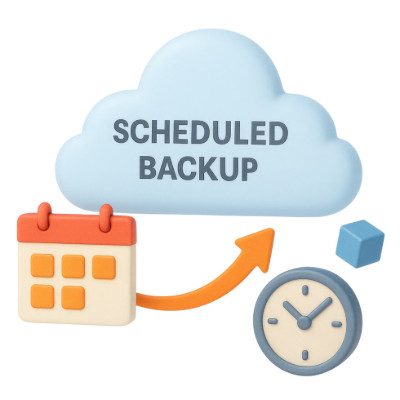
How often do you run backups of your business’ data infrastructure? If the answer is “Once a day,” or even “What’s data backup?” we need to talk. In reality, regular backups—when you take multiple backups throughout the workday—are the key to staying ahead of the dangers your business will face over the course of its life.

Cyberthreats are not just a far-off, big-corporation problem. Hackers’ goal is to steal your most valuable information—from customer lists and financial records to employee details; or money. The fallout from such an attack can be devastating, impacting not just your finances but the hard-earned trust you've built with your customers.

Technology should make running your business easier, right? Sometimes it’s simple and it does, other times, not so much and certain habits can actually cause big problems. In today’s blog, we'll look at three common technology mistakes that could be slowing you down or putting you at risk.

Data backup can be a bit nerve-wracking to implement, especially as a small business owner with limited knowledge of business IT solutions. One best practice we like to plug for SMBs is the 3-2-1 backup rule, which sounds more complicated than it really is. Today, we’re exploring the details of this approach and how it can change the way you think about backup and disaster recovery as a whole.

While it might not be the most glamorous topic, losing critical information—customer records, financial data, intellectual property—can severely disrupt, or even cripple, a business. At Cambium Data, we specialize in proactive business technology support for organizations, and we consider a robust backup and recovery strategy non-negotiable for resilience.
Think of your data as a core business asset. Protecting it requires a deliberate and multi-layered approach. Here’s a breakdown of how to build a backup and recovery plan that truly safeguards your operations.

Let's talk about something that might not be the most glamorous topic, but is absolutely vital to the health and survival of your business: data backups.
Think of your business data as the lifeblood of your operations. It includes everything from customer records and financial information to crucial project files and intellectual property. Now, imagine a scenario where this lifeblood suddenly stops flowing. What would happen?
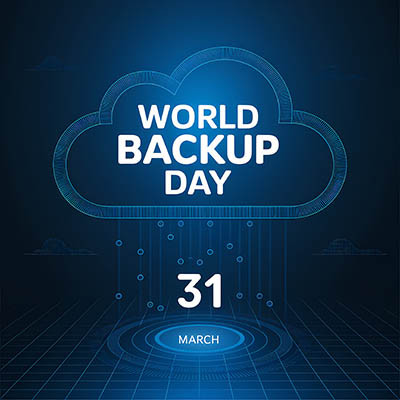
It’s World Backup Day! It’s the one day where we bring awareness to the essential process of backing up your organizational and personal data. Let’s go through some of the variables that a comprehensive data backup and recovery plan features to commemorate the “holiday.”

By now, you’ve heard us discuss how data backup is extremely important for every organization. We try to spread awareness of the negative impacts to a business that doesn’t have a comprehensive backup plan in place. Fortunately, data backup has come a long way in the past decade, making it easier, faster, and way more reliable. Let’s take a look at how things have changed in data backup.

Business continuity is a critical element of any organization’s preparations for the future, including how comprehensive the backup is designed to be. Let’s discuss the steps that businesses—especially small ones—need to take to ensure their data is protected.

For your business to achieve true business continuity—meaning you can maintain your operations regardless of disasters or issues—a data backup is a critical element of your preparations.
As such, it is critical that your backup is designed to be as comprehensive and reliable as possible.

The demand for digital storage has skyrocketed over time. While hard disk drives (HDDs) once dominated the market, solid-state drives (SSDs) are now becoming more popular thanks to their speed, durability, and increasing affordability.
That said, HDDs are still in wide use, though they are far more susceptible to failure compared to SSDs. So, how can you spot the signs that your hard drive might be on the verge of failing?

Technology has enabled us to achieve more than ever before, but with that progress comes higher expectations. Increased productivity demands can sometimes feel overwhelming, making it essential to find effective ways to manage tasks. There's a natural limit to how much we can do, however, and certain obstacles can push us to that limit more quickly. Today, we’ll explore two common productivity pitfalls that many face.
Mobile? Grab this Article